
England doesn't have a career advice shortage. It has a specificity problem.
The Rt Hon Alan Milburn's interim report on young people and work found careers guidance "widely described as generic and lacking practical value." Young people reported making decisions "without a clear understanding of the options available." If you're a careers lead, a head of computing or a senior leader with the Gatsby Benchmarks on your development plan, that word, generic, will sound familiar.
We built Tech Pathways for exactly that problem.
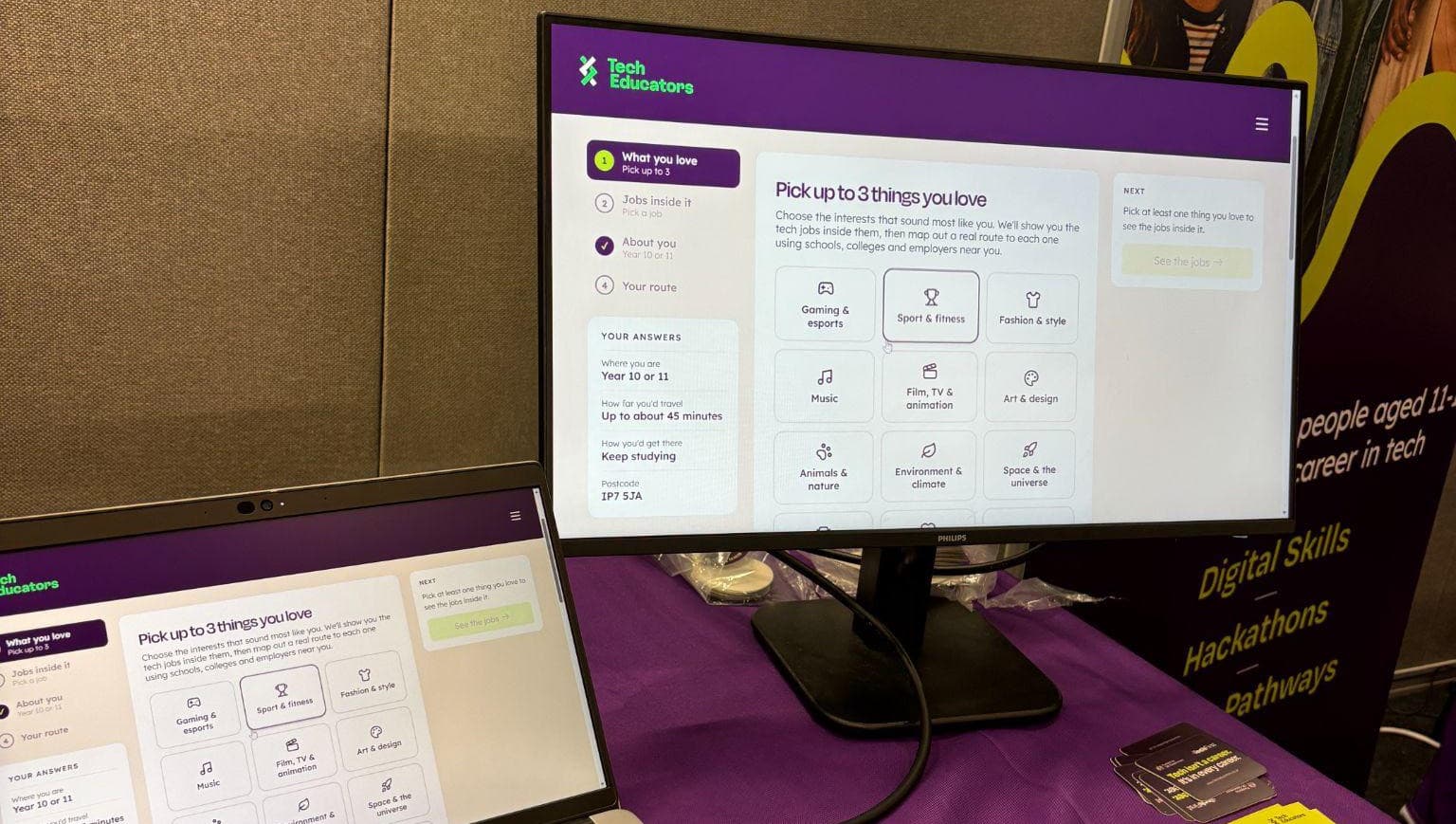
What it is: a free web tool that turns a student's interests into a step-by-step career pathway built from named local colleges, sixth forms, universities and employers.
What it costs: nothing.
What it needs: no login, no student accounts, ten minutes.
Who it's for: Years 7 to 13.
The scale of the problem
ONS figures for January to March 2026 put 1,012,000 young people aged 16 to 24 in the UK not in education, employment or training, a NEET rate of 13.5%, up 89,000 on the year. Milburn's review put the annual cost to the country at £125 billion, more than we spend on education. Six in ten NEET young people have never had a job at all, up from four in ten in 2005.
Two findings from the review shaped how we built this. First, disengagement "did not begin at 16 or 17, but much earlier, sometimes as early as Year 7." Second, work experience often "relies on who your parents know." Education and Employers' Drawing the Future found gender stereotyping in career choices visible by age seven, and that fewer than 1% of children said they'd heard about their dream job from a workplace visitor at school.
The evidence base for early, real employer contact is genuinely there, if more cautious than the headline stats suggest: Education and Employers' peer-reviewed analysis found recalling two or more employer contacts was linked to a 5 to 20 percentage point lower chance of being NEET, with a roughly 4.5% pay premium (about £900 a year) per contact recalled.
Skills England's digital and technologies skills needs assessment projects 239,000 new digital jobs by 2035, though its more cautious alternative scenario puts the figure nearer 94,000. 89% of that growth sits at Level 4 and above, so the right message isn't "you don't need qualifications for tech," it's "there are more routes to Level 4 than you've been shown." Close to 70% of the digital workforce is estimated to be male, which is why Tech Pathways opens with fashion, animals, music and helping people rather than a picture of code.
What Tech Pathways does
Students start with one question: what do you love, not what are your predicted grades. They pick up to three interests from 25 options, in the words a 14-year-old would use, and the search behind it recognises around 900 real teen search terms.
Each interest surfaces jobs in three tiers: the obvious ones (gaming leads to games programmer), the same world from a different angle (fashion leads to a data scientist forecasting trends), and the roles every industry needs (software engineer, data analyst, UX designer). That third tier is the whole argument: tech sits inside the things students already care about.
There are more than 90 roles across 18 clusters, over half of them reachable without a degree, each shown with a realistic salary range rather than a single misleading figure.
Then it builds a pathway from real places. Three short questions (year group, travel radius, earn-while-you-learn or keep studying), then a postcode, used only to measure distance and never stored. The result is a timeline naming an actual school, college, university or employer at each stage, with distance and Ofsted or TEF rating attached. It's built on a database of more than 400 schools, colleges and universities and 100 verified employers across the East of England, including Aviva, Arm, Frontier Developments, BT, Warner Bros. Studios Leavesden and Ocado's robotics team. Every step has a "pick another option" button, so the pathway rebuilds around the student's choice.
Auditing the region also surfaced real gaps worth knowing before you advise a Year 9: only three providers in the East of England run the digital T Level, and none of the seven digital-course FE colleges we checked offers a digital apprenticeship. The tool only ever shows provision that genuinely exists and is reachable, so some routes come back shorter than you'd like, deliberately.
Gatsby Benchmarks and the work experience guarantee
Tech Pathways supports three Gatsby Benchmarks directly: Benchmark 2 (real local labour market information), Benchmark 3 (pathways built from each student's own interests and circumstances), and Benchmark 4 (linking GCSE and post-16 choices to a named job). It doesn't replace Benchmark 5, encounters with employers and employees. It prepares students for them.
That matters more now the DfE's updated careers statutory guidance sets out a guarantee of two weeks' worth of work experience for every young person by the end of Key Stage 4. A student who can already name the local employers in a field they care about is easier to place.
Where this sits
Tech Pathways is part of TechFirst, a three-year, £1.49m programme funded by the Department for Digital, Culture, Media and Sport (DCMS) and delivered by Tech Educators across six counties of the East of England, reaching around 21,000 students a year. Tech Pathways itself is free for schools: no account, no student data capture, no sales follow-up.
Try it this term
Run it as a ten-minute lesson starter. Use it before an employer visit, so students arrive with a question instead of a blank page. Use it at options evenings, where a named local college and a real salary range land better than a generic leaflet.
Open Tech Pathways and try it with three interests of your own first. For a TechFirst workshop, teacher CPD session or hackathon, get in touch.
This post was written with the support of LLM input around research and development. It has been fully reviewed and edited by the Tech Educators team prior to posting. Links and facts have been verified by a human at the point of publishing.

James Adams
James has 8 years with Fortune 200 US firm ITW, experience of managing projects in China, USA, and throughout Europe. James has worked with companies such as Tesco, Vauxhall, ITW, Serco, McDonalds. James has experience in supporting start-up and scale up companies such as Readingmate, Gorilla Juice and Harvest London. James completed his MBA at the University of East Anglia in 2018.